Electrophoretic Coating vs Powder Coating: Which Is Better for Your Application?
Introduction to Modern Metal Finishing
In the competitive landscape of industrial manufacturing, choosing the right surface treatment is pivotal for product longevity and aesthetic appeal. The debate between electrophoretic coating vs powder coating has been a central focus for engineers in the automotive, appliance, and architectural sectors. Both technologies offer distinct advantages in terms of corrosion resistance, coating uniformity, and environmental impact. As global standards for durability—such as ISO 12944 and ASTM D3359—become more stringent, manufacturers must look beyond surface-level appearances to understand the underlying electrochemical and mechanical processes that define these two methods. TIMS, a leader in automated coating systems, provides the technology to implement both, but determining which aligns with your specific production goals requires a deep dive into their respective strengths.
This comprehensive guide aims to break down the technical nuances of electrophoretic coating vs powder coating. Whether you are finishing complex automotive components or large-scale architectural panels, the choice affects not only the final quality but also your operational efficiency and material utilization rates. By analyzing process principles, coating thickness control, and long-term maintenance costs, we help you make an informed decision for your next production line investment.
The Core Principles: Electrophoretic Coating vs Powder Coating
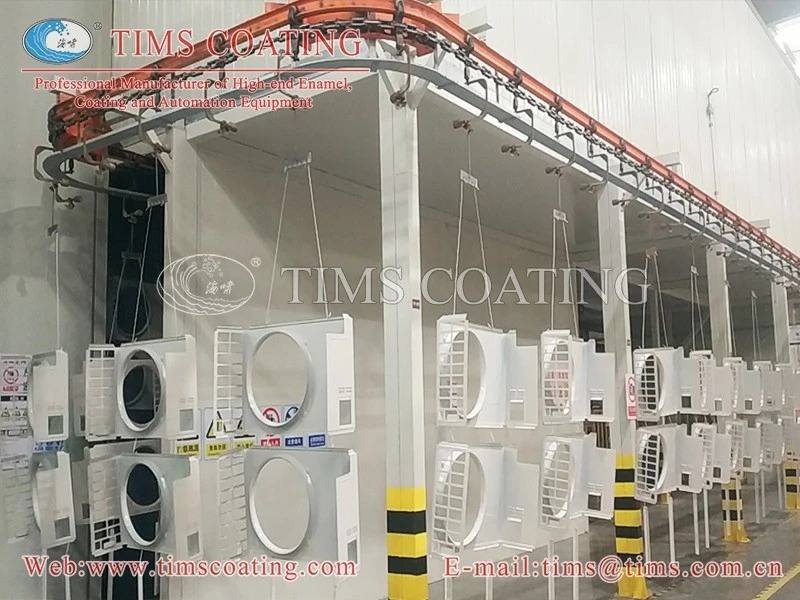
Understanding the fundamental science of electrophoretic coating vs powder coating is the first step in selecting a production method. Electrophoretic coating, often referred to as e-coating, is a liquid-based process where the workpiece is submerged in a tank containing water-borne epoxy or acrylic resins. An electric current is applied, causing the paint particles to migrate toward and deposit onto the metal surface. This creates an incredibly uniform film that reaches into every crevice, hole, and interior cavity. Because it is a dip-based process, it is inherently self-limiting; once the deposited layer reaches a certain thickness, it acts as an insulator, preventing further deposition. This ensures a consistent finish across complex geometries that are difficult to reach with traditional spray methods.
Conversely, powder coating is a dry finishing process. It uses finely ground particles of pigment and resin, which are electrostatically charged and sprayed onto a grounded workpiece. The charged powder clings to the surface until it is melted and fused into a smooth coating in a curing oven. Unlike e-coating, powder coating allows for significantly thicker layers and a wider variety of aesthetic finishes, including high-gloss, matte, and textured surfaces. However, it often faces challenges with the "Faraday Cage effect," where the powder struggles to enter deep recesses or sharp internal corners due to electrical field interference. In the context of electrophoretic coating vs powder coating, the former excels in coverage while the latter excels in film build and visual diversity.
Quality and Performance Comparison
When evaluating electrophoretic coating vs powder coating for heavy-duty applications, corrosion resistance is often the primary metric. E-coating is world-renowned for its ability to provide a robust primer layer. At TIMS, our compressor electrophoresis lines are engineered to exceed 1000-hour salt spray tests, thanks to the dense, pore-free nature of the deposited film. This makes e-coating the standard for automotive chassis and hidden structural parts where rust prevention is critical. Because the process is automated and liquid-based, the thickness is controlled precisely by voltage and immersion time, typically ranging between 15 to 30 microns.
Powder coating, while also offering excellent durability, is frequently used as a topcoat or a single-layer system for external components. It provides superior UV resistance and impact protection compared to standard e-coating finishes. Powder layers are much thicker, often between 60 to 120 microns, which helps hide surface imperfections in the base metal. In many high-end applications, manufacturers actually combine the two: using e-coating as a high-performance anti-corrosion primer and powder coating as the decorative, weather-resistant topcoat. When comparing electrophoretic coating vs powder coating in terms of finish quality, e-coating wins for precision and uniformity, while powder coating wins for toughness and aesthetic flexibility.
Operational Efficiency and Material Utilization
From a production standpoint, the choice of electrophoretic coating vs powder coating significantly impacts the bottom line. Electrophoretic lines are highly efficient in terms of material utilization. Through sophisticated ultrafiltration systems, excess paint that is not deposited on the part is rinsed off and returned to the main tank. This can lead to material utilization rates exceeding 95% to 98%. Furthermore, the automated nature of dip lines allows for high-throughput processing of large batches of small-to-medium parts with minimal labor intervention. For companies looking to reduce waste and optimize fluid management, e-coating is a superior economic choice for high-volume runs.
Powder coating also offers high material efficiency, especially with modern recovery systems found in TIMS spray booths. Overspray can be collected and recycled, though the recovery rate is generally slightly lower than that of closed-loop e-coating systems due to powder loss in filters and color change cleanouts. However, powder coating lines generally have lower initial capital expenditures for small-to-medium operations compared to the massive tank and wastewater treatment infrastructure required for a full electrophoresis line. When assessing electrophoretic coating vs powder coating, manufacturers must weigh the higher upfront investment of e-coating against the lower per-part material cost and superior automation potential it offers for large-scale industrial output.
Why Choose TIMS for Your Coating Production Line?
As a premier manufacturer with decades of expertise, TIMS specializes in designing turnkey solutions for both technologies. We understand that the decision between electrophoretic coating vs powder coating depends on your specific substrate, volume, and performance requirements. Our company stands at the forefront of coating innovation, integrating AI-powered thickness control and IoT-enabled energy recovery systems into every project. Whether you need an electrophoretic coating vs powder coating analysis for your specific facility or a custom-built powder coating production line, we provide the engineering excellence to ensure success.
Our automated production line solutions are designed to minimize environmental impact while maximizing throughput. For instance, our latest enamel and liquid painting lines utilize proprietary waste heat recovery technology, reducing energy consumption by up to 20%. By choosing TIMS, you gain access to a partner that not only supplies equipment but also provides full lifecycle support, from initial design and installation to 12 months of warranty and lifelong technical service. We help you navigate the complexities of electrophoretic coating vs powder coating to find the perfect balance for your business.
Frequently Asked Questions
Q1: What are the main durability differences in electrophoretic coating vs powder coating?
Electrophoretic coating offers superior internal coverage and corrosion resistance (often passing 1000+ hour salt spray tests), while powder coating provides better external UV resistance, impact strength, and thicker film builds for mechanical protection.
Q2: Which is more environmentally friendly: electrophoretic coating vs powder coating?
Both are eco-conscious. E-coating is water-borne and has very low VOCs with nearly 98% material utilization. Powder coating is solvent-free and allows for the recycling of overspray. TIMS systems are designed to meet strict ISO environmental standards for both processes.
Q3: Can I apply electrophoretic coating vs powder coating on non-metal substrates?
Electrophoretic coating requires a conductive surface, primarily metals. Powder coating is also mostly used for metals, although specialized low-temperature powders can occasionally be applied to certain plastics or wood. For most industrial metal finishing, both are excellent candidates.
Q4: How does the initial investment compare for electrophoretic coating vs powder coating?
Typically, an electrophoresis line requires a higher initial investment due to the complexity of the chemical tanks, ultrafiltration, and wastewater treatment. Powder coating lines are often more modular and can be scaled from manual to fully automatic more affordably.
Q5: Is it possible to use both electrophoretic coating vs powder coating on the same product?
Yes! This is a high-performance standard in the automotive industry. The product is first e-coated to provide a deep-reaching, anti-corrosive primer and then powder coated to provide a beautiful, durable, and UV-resistant finish.
Conclusion
Selecting between electrophoretic coating vs powder coating is not a matter of which technology is objectively "better," but rather which one best serves your technical requirements and budget. E-coating remains the champion of complex geometry and corrosion priming, while powder coating continues to lead the market in decorative durability and impact resistance. By understanding these differences, manufacturers can optimize their production lines to deliver high-quality products that stand the test of time.
At TIMS, we are committed to helping you achieve excellence in surface finishing. Our team of experts is ready to analyze your production needs and design a custom coating system that maximizes efficiency while minimizing environmental impact.
Ready to Upgrade Your Coating Production Line?
Contact TIMS today for a professional consultation and a tailored quote for your facility.
Get a Custom Solution Now